Strategical Options for Webvideo
THe following comes in cooperation with Bertram of gugelproductions. It is adapted to our findings in the IPTV Benchmarking Study “IPTV vs. WebTV”.
Today, producers of motionpicture and TV contents can choose from an array of platforms to provide their work to a broader audience. Conversely, platform providers in most cases can pick from a multitude of contents to offer. In times of announcements of new video sites coming in almost by the hour, VoD or streaming offers both have to stay focussed in order to asses arising opportunities. Increasingly, a seperation between Internet TV as “Over-the-top” distribution and telco IPTV as a new “institutionalized” mean of distribution becomes hard to make.
To provide a basic methodic famework for producers and platform owners, we assembled the following matrix, showing options for both sides.
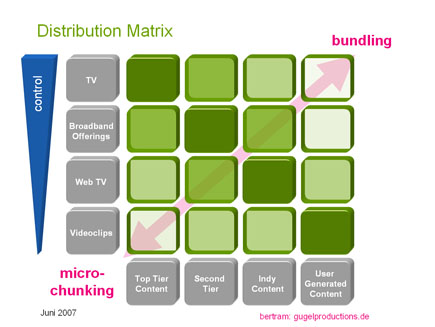
- Linearity of program and on demand availability
- Channel Control
- Programming Control
By differentiating on these criteria, one can distinguish between the following delivery mechanisms:
- TV: Regardless of which transmission technology used – cable, terrestrial, satelite or closed, IP-based networks – programing pursued by TV always is being characterised by linearity. This delivery mechanism commands a high level of control by excluding all other forms of usage and signal only can be received and decoded by standardized end-devices. Access to this form of program supply is even being regulated by the government due to limited capacity fro transmission. TV alltogther is the most closed system.
- Broadband Offerings: They are determined by an on demand provisioning of contents. However, channel control is still very present on this delivery type. In this case it is not being excerted by dedicated network structures, but by specific technologies as DRM or special types of application, which exclusively are being able to receive and display these proprietary signals. Access to Broadband Offerings is not being subject to authoreties regulation. Neverthenless platform owners issue certain requirements and rules for incorporating contents to their platforms. Examples: Joost, Babelgum, German Telekom’s T-Onlinevision, iTMS.
- Web TV: Web TV contents are being deployed on Demand, but always embody a highly serial character. Providers in this segment are clearly commanding formatting and type of contents over here, in order to not diminish the serial qualities of the program. Often, producers become platform owners in this class. In opposite to Broadband Offerings, control on the conduit is being controlled less tight. Contents are available free on the net and can be spreaded in many cases without constraints. Examples: Rocketboom, Ask a Ninja, mobuzz.tv
- Videoclips: On the bottom end videoclips or webclips make up for the most free abailable form of video content. In this class neither control of contents nor of their distribution exist. Producers and consumers enjoy both maximum freedom of choice. This leads to consumers becoming producers. Of course on demand accesibility is fully prevalent in this case. Examples are: YouTube, myVideo, Metacafe.
Looking on the horizointal axis, contents can also be divided into four categories:
Top-Tier and Second-Tier contents, Indy- and Niche contents and Prosumer- or User-Generated-Content.
- Top-tier: Expensive, valuable assets that carry the maximum possible returns . These Blockbuster-type of assets are being produced and exploited on enormous financial expenses.
- Second-Tier: Library titles and older shows, in most cases passed already all stages of the value chain.
- Indy- and Niche Contents: Include a broad array, reaching from semi-prodessional amateur movies all the way up to professionaly produced contents originating from many sources outside big, network media entities
- User-Generated-Content (UGC): All type of material produced by consumers or prosumers
This classification resulted into 16 combinations of which platform owners and producers can choose from.
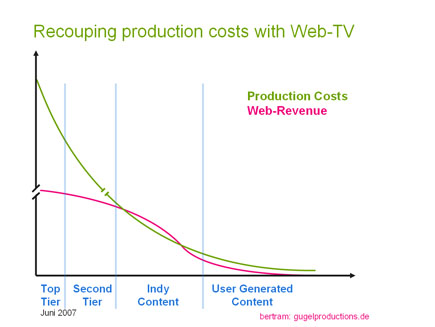
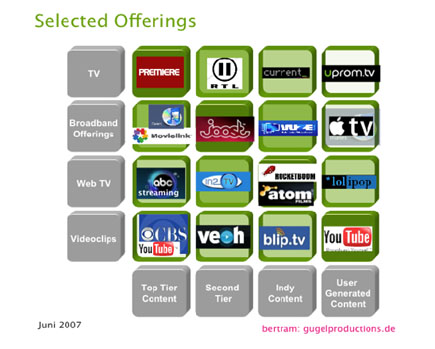
- Top-Tier Contents are increasingly offered as microchunked webclips. Perhaps the most known example in this field is “Saturday Night Live”. In the meantime there are not many premiers of shows or films left that haven’t been promoted on video platforms beforehands. Primary goal behind a Top-Tier videoclips strategy should always be to generate and increase demand on complementary platforms.
- We have witnessed various efforts to merge UGC and regular TV progaming before. Discussion on a YouTube TV channel are still going on and by its Ziddio portal Comcast setup a site aiming to move UGC videos straight onto the TV screen. Even ABC announced such a show recently with the i-Cought show, planned to be based completely on UGC.
- Rocketboom is the poster child of another combination. They are positioned around a sweet spot, being made up by a high fit to typical demand and the internets very own characteristics of a match between Indy- and Prosumer contents.
- Broadband Offerings combined with Second-Tier contents have gone large latest since movie download offerings appeared. Second-Tier is repeatedly being used for trialing platforms and asses opportunities. Joost is one example here, although they are (as many others in this lively market) a hybrid between Indy and Second-Tier distribution.
Lastly, here are the other strategic options at a glance:
- TV+Top-Tier: Focus on exclusivity- and quality
- TV+Second-Tier: Windowing, Exploitation of Evergreens
- TV+Indycontent: Aggregation und Formatting
- Broadband Offering+Top-Tier: Premium Strategy
- Broadband Offering+Indy Content: Specialinterest- und Niche Strategies
- Broadband Offering+User Generated Content: Aggregation and Packaging
- Web TV+Top-Tier: Promotion, Communitybuilding and Premium Advertising
- Web TV+Second-Tier: Formatting and Windowing, Adaption
- Web TV+UGC: Packaging
- Videoclips+Second-Tier: Platform Business
- Videoclips+Indy Content: Enabler
- Videoclips+UGC: Aggregator, Destinationsite
